
Article: What Is a Mukhi in Rudraksha? Meaning and How It Forms
What Is a Mukhi in Rudraksha? Meaning and How It Forms
The Rudraksha beads carry an inherent sense of mystery. To some people, they act as a guide and a constant companion in their spiritual journey, while to others, they are symbols of devotion and discipline. Yet behind every bead lies something far more fascinating than its appearance, a natural structure that gives each Rudraksha its unique identity.
This natural formation is known as Mukhi, and it completely changes the perception of the bead, its value, and its meaning. However, one might wonder what a Mukhi is, and why some beads seem rarer or more potent than others. It turns out that the truth behind it lies deeper than just the superficial lines.
Understanding “Mukhi” in Rudraksha
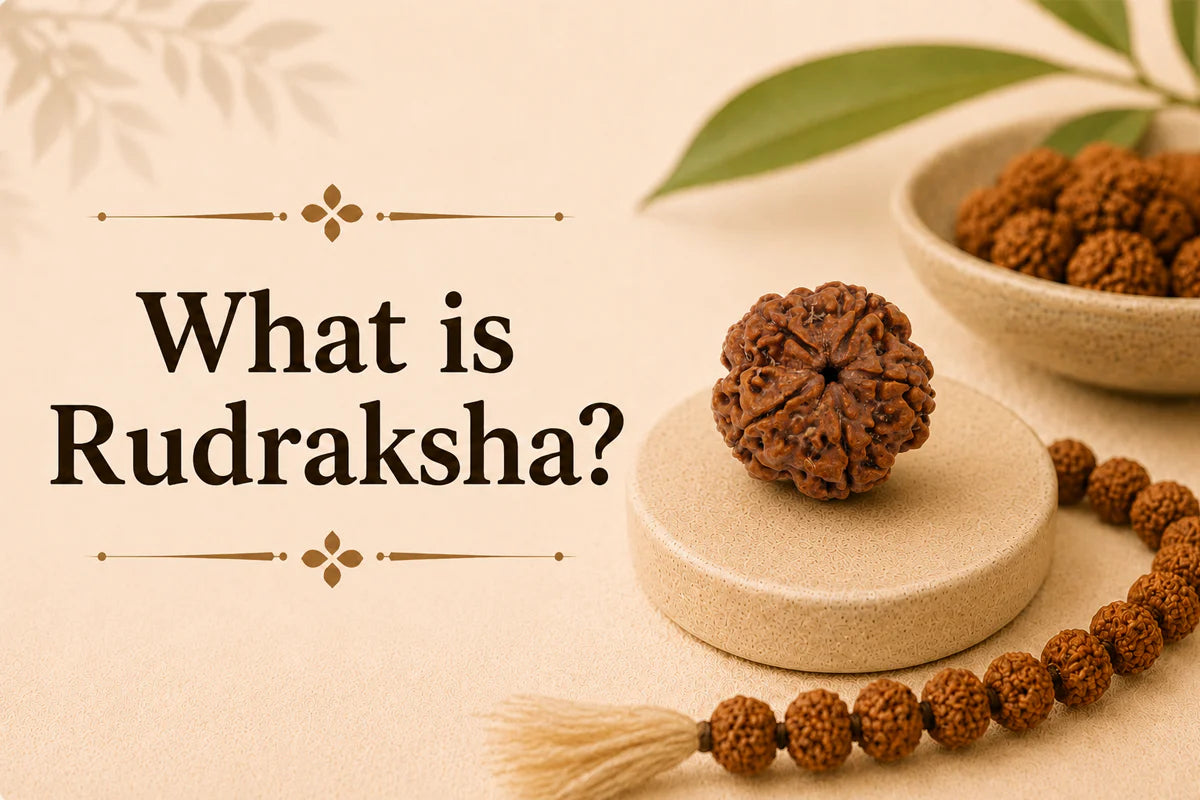
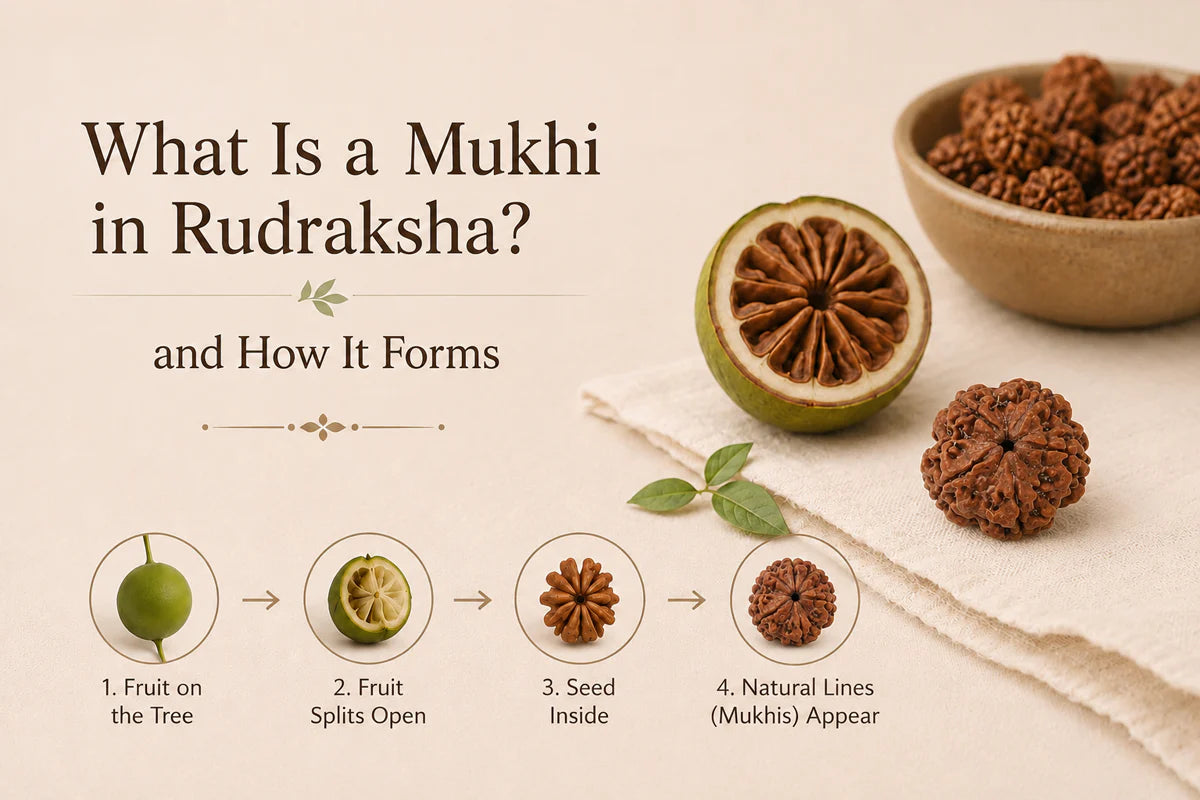
In layman’s terms, the Mukhi of a Rudraksha is the naturally occurring vertical divisions or faces of the seed from the top to the bottom side. The Mukhis are not man-made lines but develop naturally during the process of development of the Rudraksha seed within the fruit of the tree known as Elaeocarpus ganitrus.
According to traditional Rudraksha guides, Mukhi literally means “face” and describes the segments that run along the bead’s surface. Modern educational resources on Rudraksha explain that these ridges form distinct compartments, and the number of Mukhis (1 to 21 and beyond) becomes the primary way to classify a bead. Each Mukhi count corresponds to specific planets, deities, and expected life benefits in Vedic tradition, which is why sellers and priests always ask, “How many Mukhi is your Rudraksha?”
Before exploring the deeper meaning, it helps to see how this sacred seed looks from a botanical point of view.
How a Mukhi Forms: Botanical View of Rudraksha
The Rudraksha is a dried seed of the Elaeocarpus ganitrus tree, which is an evergreen large plant growing naturally in the foothills of the Himalayas in Nepal, North India, and Southeast Asia. The fruit of the tree is blue colored drupe (endocarp), which when processed becomes the Rudraksha beads.
In this endocarp, there are internal divisions of the seed known as locules, which show up externally as lines or grooves known as Mukhis. Botanical and morphometric studies involving X-ray techniques prove that the number of Mukhis is always equal to the internal division of the seed, which allows experts to authenticate and identify the species of the Elaeocarpus genus.
In other words, it implies that:
Mukhi is a physical feature of the bead, and not some decorative engraving.
The lines flow from the "head" of the bead (Brahma side) to the bottom (Shiva side), thus forming definite paths on the surface.
A bead may have anywhere from 1 to 21 Mukhis, with most commonly available beads between 4 and 7 Mukhis for general use.
Once the physical explanation is known, then comes the scriptural explanation behind them.
Scriptural Meaning: Mukhi as Faces of Consciousness
Both ancient and contemporary literature refer to Rudraksha as being derived from the phrase "Rudra + Aksha," which means the tears or eyes of Lord Shiva. According to mythology, the Rudraksha seeds came into existence through the tears shed by Rudra, signifying compassion and a desire to liberate beings from their suffering.
In such a context of symbolism, every Mukhi signifies some aspect of divine energy for example:
Spiritual commentaries & astrologers associate the 1 Mukhi Rudraksha with Lord Shiva and intense focus on liberation.
The 2 Mukhi generally signifies Ardhanarishvara, which is an amalgamation of Shiva and Shakti, and symbolizes harmony within relationships.
3 Mukhi is associated with Tridev - Brahma, Vishnu, and Mahesh, depicting the transformation of old karma.
And the list goes beyond. The compilations from Shiva Purana and other Shaiva literature inform us that these benefits occur due to the reason that each number of Mukhis is associated with a particular deity, mantra, and planetary force. In addition, the wisdom-filled texts and commentaries suggest that each of these Rudraksha faces acts as a doorway into a specific power, such as strength, vision, or riches.
With this knowledge about spiritual mapping, the cultural significance of Mukhis becomes easily understandable.
Cultural and Historical Significance of Mukhi Counts
Across India and Nepal, Mukhis define the ways of using Rudraksha in everyday life, astrology, and the rituals of pilgrimage. Devotees, priests, and astrologists correlate the faces of beads with the goals that people have, like peace, professional security, or spiritual evolution, to help people.
The patterns of culture described above are briefly outlined in various media and astrology columns:
1 Mukhi: believed to be the unique bead for spiritual evolution and liberation, used by sadhaks only.
5 Mukhi: known as the general bead, good for almost everybody, related to wellness, equilibrium, and meditation.
7 Mukhi and 21 Mukhi: connected with Mahalakshmi and Kubera, standing for prosperity.
Contemporary educational platforms and Rudraksha institutes note that these associations influence how malas are designed, which beads householders commonly wear, and how certain Mukhis appear in ritual kits offered at temples and pilgrimage centres.
Simultaneously, it must be said that scientific reviews of Elaeocarpus ganitrus reveal the medicinal and stress-relieving qualities of the seed, which means that the cultural connection combines spirituality and psycho-physiological properties.
As this knowledge becomes more accessible, sincere seekers now look beyond marketing claims and want to understand how Mukhi counts affect responsible selection and use.
How Mukhi Affects Selection and Authenticity
The Mukhi count serves as the primary criteria for determining the bead selection and verifying authenticity for present-day users. Some of the ways recommended by reliable educational sources for Rudraksha include:
Take an accurate count of the number of Mukhis, and ensure that the lines are uninterrupted and equally spaced out without any scratches.
Go for those beads that have undergone X-ray examinations to ensure that the segmentation inside the bead corresponds to the outside Mukhi count.
Consult reliable charts, which correlate the number of Mukhis with the corresponding deity and planets and their use.
This bridge between tradition and research prepares the ground for a balanced conclusion about what a Mukhi truly represents.
Conclusion: Mukhi as the Map of a Sacred Seed
Mukhi is the part of a Rudraksha bead that gives it identity. These natural lines are not decorative; they are part of the seed’s own structure, and they are what people use to classify the bead and understand its traditional significance.
That is why Rudraksha is read on two levels at once. Botanically, the faces come from how the seed forms inside the fruit. Spiritually, they are treated as signs of different energies, deities, and purposes, which is why authentic beads are checked carefully rather than judged by appearance alone.
For anyone studying Rudraksha seriously, the main idea is simple: the Mukhi tells the story of the bead. Learn to read that structure properly, and the rest of the tradition starts to make sense.