

12 Jyotirlingas of India: History, Significance & Guide
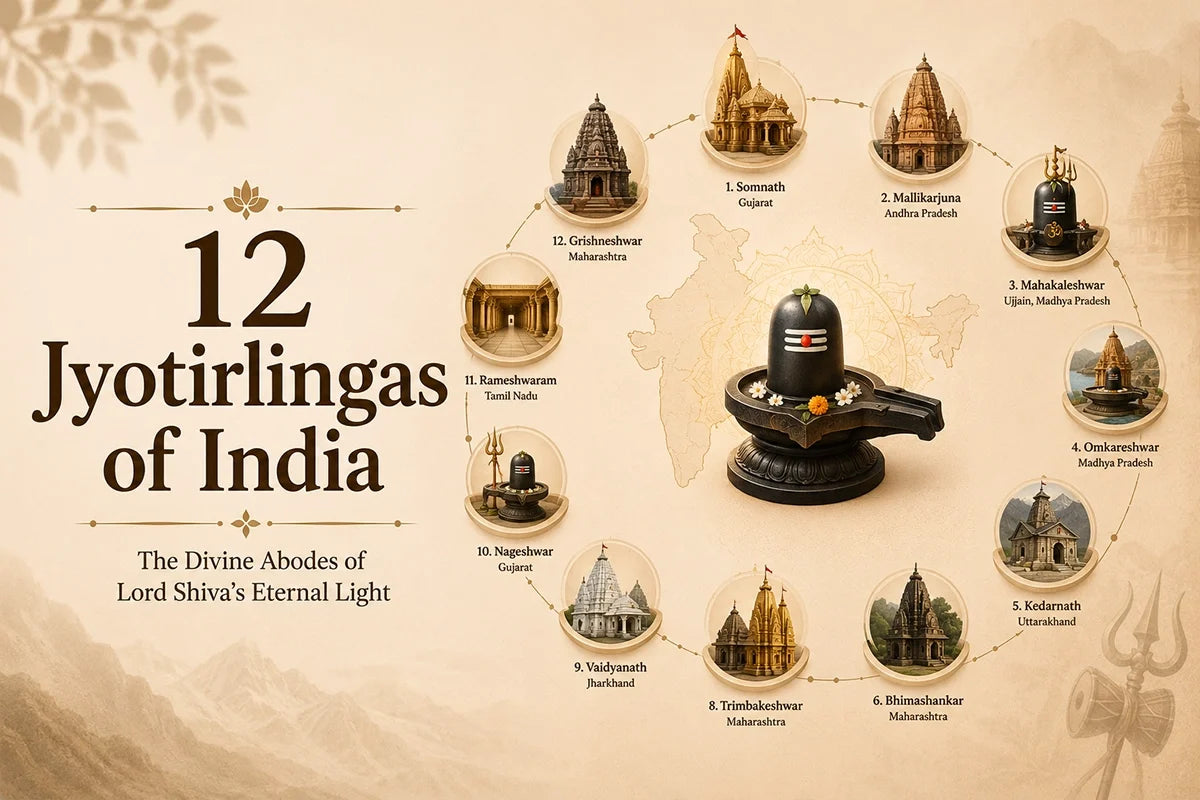
The 12 Jyotirlingas in India are considered to be the holiest shrines in existence dedicated to Lord Shiva and regarded for their long-held tradition of worshipping Shiva in the form of an endless stony pillar of light. The Shiva Purana mentions these 12 shrines, which are situated in various parts of India, with every temple boasting its own rich heritage, folklore, and religious importance. Collectively, they signify the presence of Lord Shiva and offer a way to devotees to make their spiritual journey.
This blog elaborates on the term "Jyotirlinga," in addition to the engaging mythology surrounding their inception, number 12’s significance in Hinduism, and the uniqueness of myths associated with every one of the mentioned shrines. This article is a great reference for those wishing to participate in Dwadash Jyotrilinga Yatra, for those seeking insight into the philosophy of Shaivism, and for those wanting to know more about the most popular shrines in India.
Introduction – Shiva Beyond Temples, Mountains, and Directions
Na tasya pratima asti. There is no way to capture the essence of Lord Shiva. But out of utmost compassion, Lord Shiva manifests in various forms through which believers can feel his divine presence.
Shiva is not restrained by a specific place, but he is infinite wherever he may be. The Jyotirlingas are twelve rays of that indescribable light scattered across India and a reminder of the presence of the divine everywhere. Every religion has its sacred sites, but Hinduism has something special – the Jyotirlinga. They are not just temples built by kings or rock monuments but places where Lord Shiva has appeared as the never-ending column of light.
For the millions of devotees, the Jyotirlingas represent not only holy pilgrimage sites but also the spiritual process of faith, time, devotion, and self-exploration.
What does Jyotirlinga mean?
The term "Jyotirlinga" is made up of the two Sanskrit words:
Jyoti—a divine light.
Linga—the sacred mark that represents the limitless and formless consciousness of the Lord Shiva.
That's why the term "Jyotirlinga" means “the shining symbol of the limitless Lord Shiva."
Shiva Linga marks the formless aspect of the Divine, while temples and images are designed to have a visible shape. Thus, it gives a possibility to understand that God goes beyond all forms, names, and limitations.
According to the Linga Purana, the Linga remains the universal column into which everything disappears and comes from. Hence, the worship of a Jyotirlinga is equal to the worship of the Supreme being itself.
Meaning of “Jyoti” and “Linga”
The meaning of the term “Jyoti” translates to the belief of “not a common light.” This terminology symbolizes spiritual enlightenment, wisdom, truth, and divine consciousness. Just as sunlight can reduce physical darkness, divine light has the potential to remove ignorance from a human being’s mind.
Alternatively, the term “linga” can lead to misunderstandings. In Indian philosophy, it is not just a religious symbol but a very potent universal symbol. This term symbolizes the endlessness of Brahman, which seems to be the supreme consciousness that never was born and will never die.
Overall, Jyoti and Linga represent the wonderful truth that Lord Shiva is the eternal light shining on all lives.
Why is a Jyotirlinga different from an ordinary Shiva temple?
Numerous temples in India worship Lord Shiva. Each temple is very important in its own way and serves as a sanctuary for pilgrims. But twelve Jyotirlingas have special importance in Hinduism. According to the Shiva Purana, these holy shrines show where Lord Shiva worshiped himself as a never-ending light. Jyotirlingas are regarded as swayambhu and are different from other holy places as they have been established by themselves.
It is noteworthy that each Jyotirlinga signifies a special divine blessing. Different Jyotirlingas are visited by devotees with different demands like healing, safety, liberation, wisdom, prosperity, valor, or peace of mind.
The Jyotirlingas as a whole demonstrate the presence of Lord Shiva across the territory of India.
The divine story behind the creation of the 12 Jyotirlingas
The creation of the Jyotirlingas is explained in one of the Shiva Puranas'Purana's best-known stories.
Lord Vishnu, the protector, and Lord Brahma, the creator, got into a disagreement long ago. Each thought he was the best of all the gods and wanted to be acknowledged as such.
As the disagreement intensified, an astonishing phenomenon occurred. Suddenly, a massive pillar of brilliant light appeared in front of them. All directions were lighted by its brilliance, and neither its beginning nor its end was seen.
The debate between Lord Brahma and Lord Vishnu
Lord Vishnu, determined to fix the problem, took on the shape of Varaha, the divine boar, and travelled deep into the universe to find the base of the pillar.
Lord Brahma, meanwhile, changed into a swan and flew high to reach its peak. Neither of them was able to reach the end of the heavenly light after their almost limitless travels across limitless regions. Lord Vishnu kindly acknowledged that the pillar was endless after realizing the pointlessness of their search. But Brahma claimed to have reached its peak.
The Shiva Purana claims that Shiva came from the pillar and exposed Brahma's lies. Consequently, Brahma was cursed so that there would be very few temples devoted only to him.
The appearance of the infinite pillar of light
The endless pillar of light was not only a display of divine power but also a symbol of the ultimate reality that rises above creation itself. Originless, ending nowhere, and lacking a measurable presence, Jyotirlinga represents eternal intelligence, the source of the universe, and the home of everything in the end. Thus, the boundless brightness turned into Jyotirlinga, proving that the Divine cannot be constrained by its material representation or understood by humans.
Lord Shiva’s revelation as the beginningless and endless reality
Lord Shiva declared Himself Anadi (without beginning) and Ananta (without end) when He emerged from the pillar of light. He claimed that while creation, preservation, and death are essential cosmic tasks, the supreme Reality exists beyond all three.
It is thought that the twelve Jyotirlingas are sacred locations where people can experience this boundless heavenly light. They serve as a reminder to followers that there is only one timeless awareness behind all visible forms.
Mystery of 12: why are there exactly twelve Jyotirlingas?
Devotees often wonder why Lord Shiva especially took on twelve holy forms. Twelve is associated with both the rhythm of time and cosmic unity in Hindu philosophy. It appears often throughout Vedic tradition:
-
The full cycle of time is represented by the 12 months of the year.
-
The Sun's various manifestations are represented by the 12 Adityas.
-
The 12 zodiac signs rule astrology order.
-
Twelve major forms of Surya, which represent the ever-changing cycles of life and the seasons, are also described in ancient texts.
Lord Shiva, known as Mahakal—the Lord beyond eternity—crosses these cycles while simultaneously controlling them. The twelve Jyotirlingas, therefore, symbolize His presence in every phase of existence, reminding followers that no matter where they are or what stage of life they are in, Shiva's divine mercy is always accessible.
The twelve jyotirlingas of India and the divine blessings they hold
Each of the twelve Jyotirlingas is more than a holy destination; it is a divine center of spiritual energy, carrying a unique blessing and representing a distinct aspect of Lord Shiva. Together, they form a spiritual map of India, guiding devotees toward faith, inner peace, and liberation.
Somnath Jyotirlinga – The temple that refused to disappear
Location: Prabhas Patan, Gujarat
Somnath, which refers to "Lord of the Moon," is considered to be the first of the twelve Jyotirlingas. The Shiva Purana states that Chandra, the Moon God, lost his brightness when his father-in-law, Daksha Prajapati, cursed him. Chandra worshipped Lord Shiva and performed great meditation at Prabhas Kshetra in an attempt to find forgiveness. The moon's rising and falling phases were created when Shiva, pleased by his devotion, partially lifted the punishment. Somnath is also celebrated for its extraordinary resilience. Throughout history, the temple was destroyed and rebuilt several times, becoming a symbol of unwavering faith. It reminds devotees that while physical structures may be damaged, true devotion can never be destroyed.
Blessing: Renewal, hope, strength, and resilience during difficult times.
Its message is powerful: Truth may be challenged, but faith always rises again.
Mallikarjuna Jyotirlinga – The abode of divine parents
Location: Srisailam, Andhra Pradesh
Mallikarjuna, located high above the sacred Nallamala Hills, is one of the few shrines where Lord Shiva and Goddess Parvati are worshipped together as Mallikarjuna and Bhramaramba. Tradition holds that Shiva and Parvati went to Srisailam to stay near their son and bless devotees after Lord Kartikeya decided to live on Mount Krauncha. This holy place represents the value of family and the love and compassion of divine parents. The temple is a unique pilgrimage site where Shiva and Shakti are worshipped at the same time because it is also regarded as one of the 18 Shakti Peethas.
Blessing: Harmony in relationships, family unity, compassion, and divine protection.
This Jyotirlinga teaches a beautiful lesson: Divinity is not only found in meditation and renunciation but also in love, family, and compassion.
Mahakaleshwar Jyotirlinga – Lord of time and death
Location: Ujjain, Madhya Pradesh
The only Dakshinamukhi (south-facing) Jyotirlinga, which is particularly auspicious in Shaivism, is Mahakaleshwar. Here, Shiva is worshiped as Mahakal, the Lord who surpasses death, time, and fate. Legend has it that Shiva made an appearance in Ujjain to shield followers from the demon Dushana. He established His eternal presence in the city by taking on the form of Mahakal and defeating evil. One of the temple's most famous rituals is the Bhasma Aarti, performed before sunrise using sacred ash. It is a potent reminder of the passing of existence and the soul's eternal essence.
Blessing: Freedom from fear, protection from negative energies, courage, and spiritual awakening.
Lesson behind it: Mahakaleshwar reminds devotees to live fearlessly because time itself bows before Lord Shiva.
Omkareshwar Jyotirlinga—The sound from which creation began
Location: Mandhata Island, Madhya Pradesh
Omkareshwar is a unique location on land that is naturally shaped like the sacred syllable "Om" (ॐ). It is hidden away on an island in the Narmada River. The Shiva Purana states that King Mandhata and the Devas' severe penance caused Shiva to appear here. Omkareshwar represents the beginning of creation and cosmic vibration since Om is thought to be the primal sound from which the universe originated. Pilgrims frequently participate in the island's parikrama because they think it offers heavenly favor and spiritual purification.
Blessing: Inner peace, clarity of mind, spiritual growth, and harmony with the universe.
Represents: Omkareshwar, therefore, represents the beginning of existence itself.
Kedarnath Jyotirlinga—The temple closest to heaven
Location: Rudraprayag District, Uttarakhand
Kedarnath is one of the world's highest and best-known Shiva temples, rising to a height of about 3,583 feet. After the Kurukshetra war, the Pandavas sought Lord Shiva to request forgiveness for the harm wrought during the battle. Shiva took on the shape of a bull in order to test them. Shiva vanished into the earth after Bhima identified Him, leaving behind His hump, which is now revered as the Kedarnath Jyotirlinga. The hard walk to Kedarnath shows that a spiritual climb demands perseverance, discipline, and deep faith. Surrounded by snow-covered Himalayan peaks, the temple invites calm, humility, and submission.
Blessing: Forgiveness, liberation from past karma, determination, and spiritual endurance.
The message: The highest blessings are reached through faith, patience, and surrender.
Bhimashankar Jyotirlinga – The protector of dharma
Location: Maharashtra
According to ancient tradition, the demon Bhima spread fear and terror among sages and devotees. Lord Shiva emerged in response to their prayers, defeated the demon, and restored justice. Located within the beautiful Sahyadri forests, Bhimashankar is also credited with the origin of the Bhima River, adding to its spiritual significance. The temple serves as a reminder to devotees that people who follow the path of truth are always protected by God and that Dharma always wins against injustice.
Blessing: Courage, protection from adversity, victory over negativity, and righteousness.
Teaching: It teaches us that divine power always stands beside righteousness.
Kashi Vishwanath Jyotirlinga – The city where Shiva never sleeps
Location: Varanasi, Uttar Pradesh
One of the oldest continuously occupied towns in the world is Kashi, sometimes called Varanasi. Hindus believe that Vishwanath, the Lord of the Universe, is actually Lord Shiva. The Skanda Purana's Kashi Khanda refers to Kashi as Avimukta Kshetra, the city that Shiva never left behind. Many devotees travel to Kashi in search of spiritual liberation (moksha), as it is thought that those who recall Shiva there receive His blessing. Kashi is a live center of devotion because of the holy Ganga, evening Ganga Aarti, and the constant chanting of "Har Har Mahadev."
Blessing: Spiritual wisdom, inner transformation, liberation, and divine grace.
Its message: Life is temporary. The soul is eternal.
Trimbakeshwar Jyotirlinga – The temple of wisdom
Location: Nashik, Maharashtra
Brahmagiri Hill, the ancient source of the holy Godavari River, is located close to Trimbakeshwar. Legend has it that Lord Shiva brought the holy river to earth after Sage Gautama engaged in severe penance here. The Jyotirlinga at Trimbakeshwar is special because it depicts the Trimurti—Brahma, Vishnu, and Shiva. It is also one of the most significant locations for carrying out ancestor rites, Kaal Sarp Dosh, and Narayan Nagbali. Knowledge, purification, and the release of karmic baggage are all symbolized by the temple.
Blessing: Wisdom, prosperity, purification, and freedom from karmic obstacles
Teaching: Trimbakeshwar, therefore, represents cleansing of the mind, wisdom, and spiritual knowledge.
Vaidyanath Jyotirlinga – Shiva, the divine healer
Location: Deoghar, Jharkhand (widely accepted tradition)
Vaidyanath's name means "Lord of Physicians." To satisfy Lord Shiva, Ravana is said to have offered his heads one by one in devotion and engaged in extreme sacrifice. Before the last offering, Shiva arrived, healed him, and offered him heavenly benefits, earning the name Vaidyanath. Devotees come to the temple today in search of healing from spiritual turmoil, emotional pain, and physical illness. The great devotion connected to this Jyotirlinga is seen in the well-known Shravani Mela, when millions of Kanwariyas carry sacred Ganga water to present to the shrine.
Blessing: Healing, good health, emotional balance, and inner peace.
Teaching: Devotees pray not only for physical health but also for emotional and spiritual healing.
Nageshwar Jyotirlinga – The destroyer of fear
Location: Near Dwarka, Gujarat
Nageshwar shows Lord Shiva as the guardian against fear, poison, and evil forces. Legend has it that after sincere prayers, Shiva saved His disciple Supriya from the monster Daruka. This story highlights that even in the most extreme situations, genuine dedication calls forth supernatural protection. The serpent around Shiva's neck signifies power over fear, ego, and destructive passions. It represents total control over the forces that bond humans, not danger.
Blessing: Fearlessness, confidence, protection, and spiritual strength.
Teaching: Nageshwar teaches that fear disappears when faith becomes stronger than doubt.
Rameshwaram Jyotirlinga – Where Lord Rama worshipped Lord Shiva
Location: Tamil Nadu
Rameshwaram occupies a unique place among the Jyotirlingas because it unites two of Hinduism's main traditions—Shaivism and Vaishnavism. Before crossing the ocean to Lanka, Lord Rama built and worshipped a Shiva Linga to seek blessings for victory and to reverence Shiva. After returning from Lanka, he again worshipped Shiva to atone for the harm committed during the war. The temple's majestic hallways and 22 sacred wells (Theerthams) attract pilgrims from throughout the world.
Blessing: Humility, success, purification, and harmony.
Teaching: This temple beautifully teaches humility.
Grishneshwar Jyotirlinga – The reward of unwavering devotion
Location: Chhatrapati Sambhajinagar (Aurangabad), Maharashtra
The unwavering devotion of Ghushma (Kusuma), who worshipped Lord Shiva by submerging hundreds of Shiva Lingas in a nearby pond every day, is linked to Grishneshwar, the twelfth Jyotirlinga. She experienced a great deal of personal suffering, but she never gave up on her faith. Inspired by her unwavering devotion, Lord Shiva appeared as Grishneshwar and brought her happiness back. Sincere dedication, patience, and submission always draw heavenly grace, as the temple eloquently demonstrates.
Blessing: Devotion, perseverance, peace, and fulfillment of righteous desires.
Teaching: The final Jyotirlinga symbolizes pure devotion.
The hidden spiritual secret of the twelve Jyotirlingas
The twelve Jyotirlingas are not random sites spread throughout India. The Himalayas, rivers, forests, plains, deserts, and oceans are all connected by a sacred spiritual network. This global dispersion clearly shows how Lord Shiva's influence surpasses all boundaries in both nature and human culture. From hope and healing to wisdom, courage, surrender, and ultimately freedom, each Jyotirlinga symbolizes a stage in a devotee's spiritual path on a deeper level. Traveling throughout India is just one aspect of the pilgrimage; another is changing oneself on the inside.
Can everyone complete the 12 Jyotirlinga Yatra?
For many devotees, finishing the Dwadash Jyotirlinga Yatra is a dream come true. However, the path is frequently challenging due to factors including age, health, time restraints, family obligations, and financial limitations. Physical distance is not as significant as Bhava, or true devotion, according to Hindu texts. Sacred acts of worship include really remembering Lord Shiva, reciting His names, reading the Jyotirlingas, and making sincere prayers. Before a pilgrimage starts on the path, it starts in the heart.
Carry the blessings of all twelve Jyotirlingas close to your heart.
Every devotee can maintain a spiritual connection to the twelve Jyotirlingas, even if they are unable to visit them all. This spiritual feeling serves as the inspiration for Rudraksha Raksha's Dwadash Bhumi Panchmukhi Rudraksh Mala. It incorporates consecrated soil linked with the territories of the twelve Jyotirlingas, symbolically bringing together the blessings of 12 holy shrines in one spiritual mala. Wearing it throughout daily prayers, meditation, travel, or work serves as a reminder of the everlasting teachings of the Jyotirlingas and the ever-present grace of Lord Shiva.
Conclusion
The twelve Jyotirlingas are living manifestations of Lord Shiva's boundless light, compassion, and cosmic consciousness; they are more than just hallowed temples. Each shrine offers a special spiritual benefit to those who enter with sincerity while telling a tale of faith, devotion, sacrifice, and divine favor.
Lord Shiva is not limited to stone, ritual, or location, regardless of whether you stand in front of the ancient shoreline of Somnath, hike across the Himalayas to Kedarnath, seek freedom in Kashi, or just think about these hallowed places from your house. Every heart that calls on Him with unshakable trust contains Him.
May the holy light of the Dwadash Jyotirlingas illuminate your path, empower your spirit, remove impediments, and guide you toward wisdom, inner peace eventually, and moksha.
HAR HAR MAHADEV!