
Defective Rudraksha: Signs of a Bead You Should Not Wear
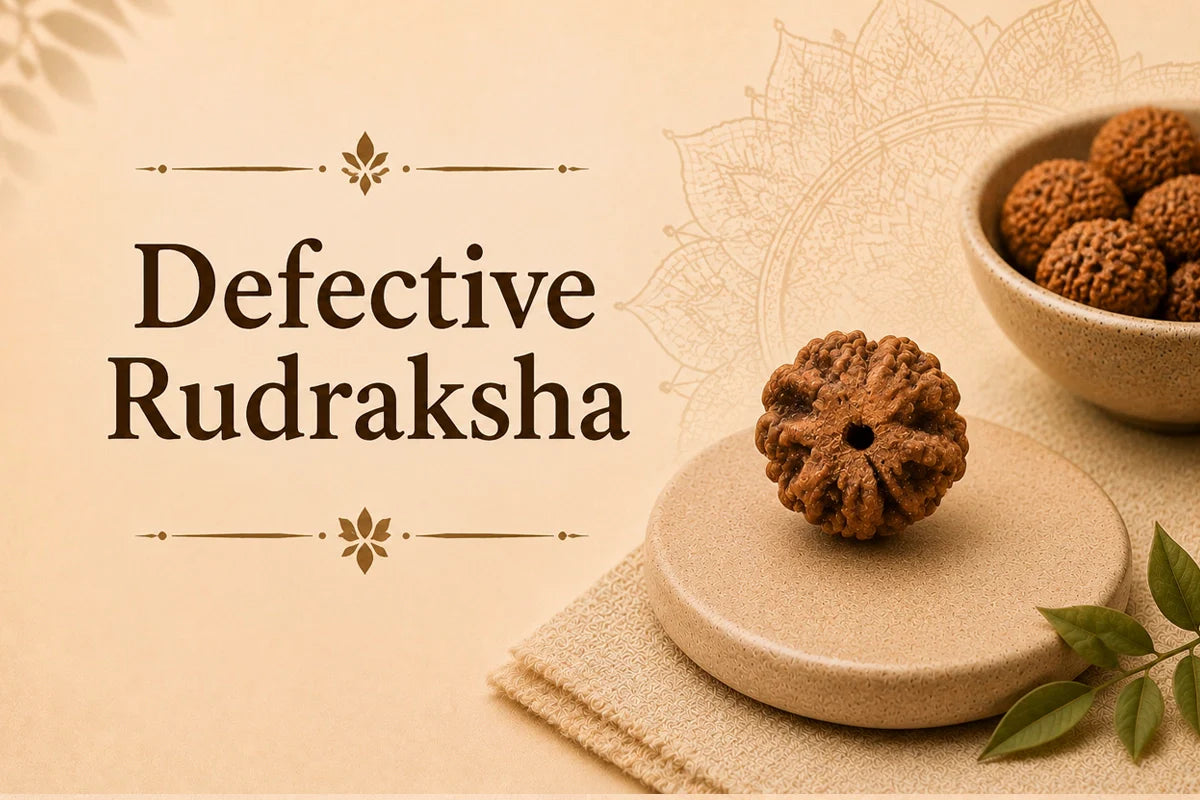
More than just a holy seed, the Rudraksha is perceived as a divine gift related to Lord Shiva. For centuries, devotees have worn original Rudraksha beads to achieve spiritual development, emotional balance, mental clarity, and defense.
But it is essential to note that Rudraksha beads are not appropriate for wearing.
Some Rudraksha beads can become defective because of nature’s calamities, mishandling, old age, or synthetic alteration. Wearing a defective Rudraksha can diminish its natural power and indicate deterioration of the underlying structure of the bead.
Quite often, people misinterpret naturally imperfect Rudraksha seeds as defective. However, the truth lies in the fact that each Rudraksha is different in its growth since imperfections are perfectly normal. What is of concern is the health and natural essence of the Rudraksha.
This guide will let you know about the major characteristics of a damaged Rudraksha that will help in recognizing it, as well as the actions needed to be taken in case your bead becomes defective.
What does the term "defective Rudraksha" mean?
Defective Rudraksha is a bead that has experienced either natural wear and tear or major alterations done by humans that affect its quality and authenticity. Rudraksha beads that are not symmetrically shaped but are formed naturally and display unique grooves are not defective. Each bead has its own distinctive characteristics, as it is a natural seed. Concerns arise when the bead becomes damaged, such as a broken, cracked, or decayed bead that has been subjected to chemical treatments or alteration.
10 signs of a defective Rudraksha
It is important to examine any Rudraksha that you plan to wear. Natural differences in the shape and texture of Rudraksha beads are common, but the defects in the bead can affect its durability and authenticity. The following indications will tell you whether a Rudraksha bead is distorted or changed chemically and not suitable for your use.
1. Visible cracks running across the bead
Deep cracks throughout the rudraksha bead are one of the most recognizable indications of a cracked rudraksha. Structural cracks differ from natural lines on the bead in that structural cracks become weak and can potentially split the bead altogether. In the event that the crack exposes the inner core, it is advisable to abstain from wearing the bead.
2. Broken mukhis (natural faces)
The mukhis are the natural lines visible on the Rudraksha. In instances where these mukhis have become dented, broken, or completely missing due to damage, further inspections should take place.
In the same vein, if a mukhi appears broken, it can be an indication of either accidental harm or poor preservation.
3. Artificially carved lines
These may indicate that extra lines have been added to the ordinary mukhi beads to convert them into high-value items. Artificial carvings can be noticed due to:
- Extremely sharp markings.
- Markings that are absolutely symmetrical.
- Surfaces that differ significantly from natural lines.
- Ka beads have very fresh and clear carvings.
These considerations constitute a huge warning sign in distinguishing fake vs. real rudraksha seeds.
4. Holes caused by insects
As natural seeds, Rudraksha seeds sometimes become infected with insects during incorrect storage. If you observe tiny holes, powdery residue, or something resembling internal rot in the bead, then it means that insects have infected it. This kind of infected Rudraksha tends to become weak from a structural perspective and should therefore not be used.
5. The bead is splitting apart
A properly cared-for Rudraksha can last for decades. If the bead begins to split, develops crevices, or is loose on the inside, it means it has probably seen its best days and has to be put to rest. A broken rudraksha must be treated with respect, not worn for good luck.
6. Chemical coating or artificial polish
Certain distributors of the beads make use of varnish, polish, chemicals, and wax to make their beads appear new. Here are the signs:
-
High shine
-
Sticky feel
-
Chemical odor
-
Fake color
Genuine Rudraksha has a naturally raw look and not a glossy one.
7. Extremely soft or powdery surface
An authentic bead will be inherently hard. In any case where the external look wears easily or has an abnormal soft touch, it is the signal of the beginning decay of the inside part of the bead.
8. Large chipped portions
Some small natural imperfections may be present. Yet, in cases where larger portions of a bead are damaged by an accidental impact, the bead's original structure will be lost. Rudraksha beads that have significant damage are classified as defective.
9. Damage caused by heat or chemicals
People may unintentionally expose Rudraksha to very hot water, perfumes, soap, hair-styling sprays, and cleaning chemicals. In time, these items above will dry the seed and may create microscopic fractures that will later become visible. Proper care greatly extends the life of a Nepal Rudraksha or any genuine Rudraksha.
10. Artificially drilled or enlarged hole
Each Rudraksha contains a natural central channel. Some sellers will use machines to enlarge this or create internal cracks. If there is visible unevenness, roughness, or cracking of the bead due to misuse of drilling operations, do not wear it.
How to identify a defective Rudraksha?
Before buying or wearing a Rudraksha, go through it thoroughly. Check for the following defects:
-
Severe cracks
-
Broken parts
-
Fake carvings
-
Wormholes
-
Fragile structure
-
Chemical polish
-
Missing mukhis
-
Internal splits
The chance of getting a defective Rudraksha can be significantly reduced when it is bought from a reputable vendor with an authenticity certificate.
What should you do if your Rudraksha becomes defective?
If your Rudraksha has been damaged after years of usage, there is no need to worry. Traditionally, it is advised to:
-
Discontinue wearing the broken bead.
-
Clean it with fresh water.
-
Pray to Lord Shiva.
-
Place it in your household temple.
-
Alternatively, the Rudraksha can also be immersed in the river or buried under a healthy tree.
Avoid throwing a Rudraksha into the trash, as it is regarded as a sacred object.
How to keep your rudraksha safe from damage
Taking care of your Rudraksha keeps it safe and lets you enjoy its beauty for as long as possible. Here are a few suggestions for proper Rudraksha care:
-
Keep the Rudraksha occasionally cleaned with water at room temperature.
-
Avoid using hot water and chemical cleaners.
-
Apply a little amount of natural oil occasionally to keep it from drying.
-
Keep it away from moist places.
-
Change the used threads whenever necessary.
-
Be careful not to drop the Rudraksha on a hard floor.
-
Stop doing activities that expose it to chemicals and moisture.
These habits help maintain your Rudraksha for many years.
Does a naturally imperfect Rudraksha mean it is defective?
No, it is not true. Nature creates no Rudraksha beads that are identical.
Differences between Rudraksha beads regarding size, shape, color, texture, and depth of grooves are all natural. Many powerful Rudraksha beads have irregular forms. The important point is that it is naturally formed, structurally strong, and free of unnatural changes and significant damage.
Conclusion
A defective Rudraksha is not just an unusual bead but one that has undergone serious structural damage or has been altered in an unnatural way. Knowing how to discover a defective Rudraksha allows you to avoid buying false or damaged Rudraksha beads and enjoy the real Rudraksha benefits of genuine Rudraksha. Before wearing any Rudraksha, check it for cracks, insect infestation, artificial patterns, broken mukhis, and chemical processing. A genuine Rudraksha must be treated with respect, as otherwise, it will not be fruitful for the owner.